Scoring System
How it works and future enhancements
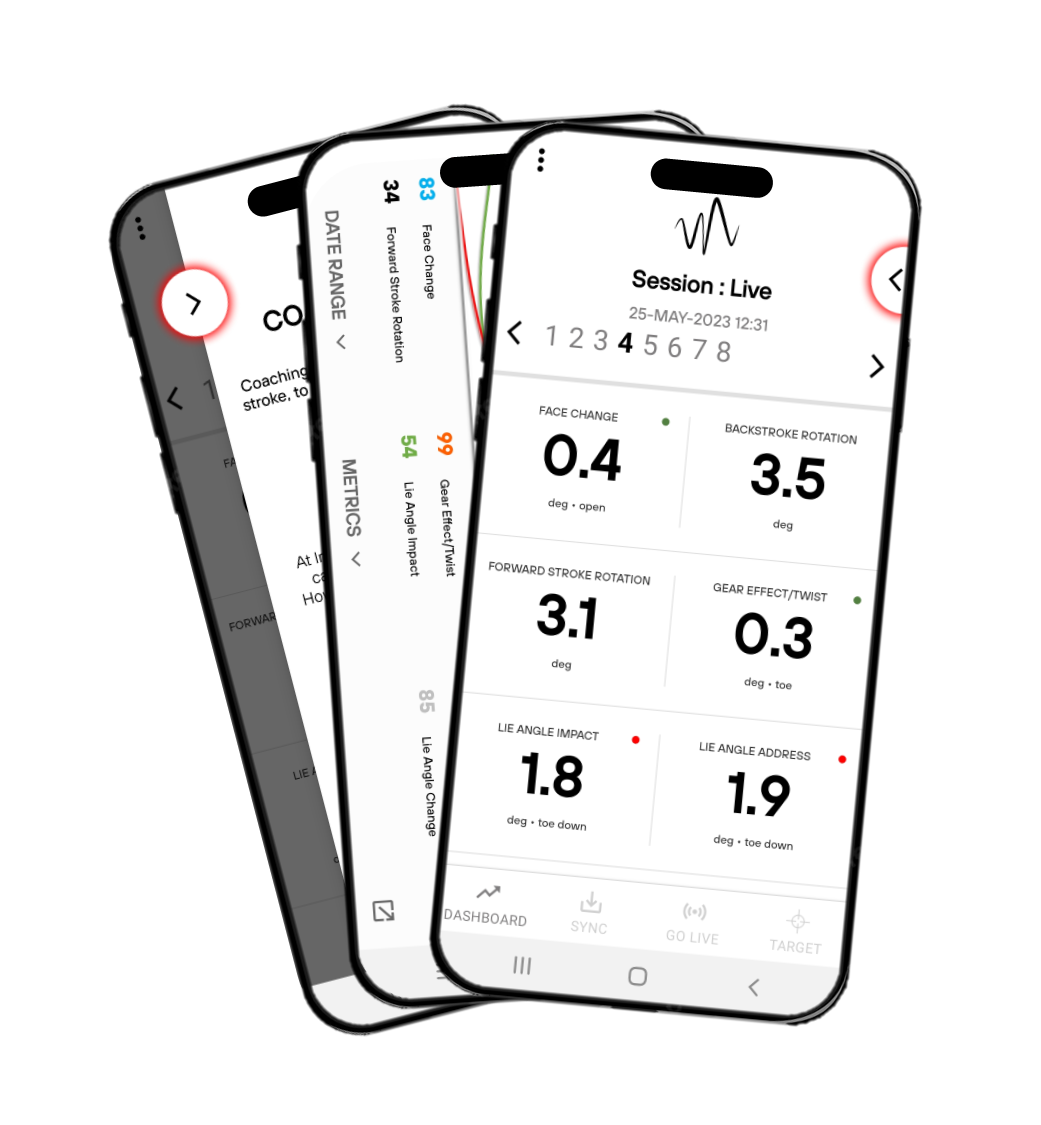
The Vertex Golf scoring system is engineered to be simple and intuitive as possible. It is designed to give the end user guidance as to where they are doing well and where improvements can be made.
Accuracy:
There are some measurements in golf which are definitive, for example when it comes to measures such as Aim (at Impact), we are looking to achieve as close and consistently as possible to 0.0° as we can.
However there are many measures where the results need to be taken in to context.
For example… If a person has an Aim (At Address) of 1° closed, BUT they have a Face Change of 1° open, these will effectively cancel each other out, to provide an Aim (At Impact) of 0°.
It is our intention at Vertex Golf to be fully transparent in how things are calculated and further more in the future will providing coaches and golfers the ability to manage these settings themselves, to fit their own beliefs on what numbers are good or bad.
We will be releasing future updates which will allow the user to do the following.
(1) Switch between modes of difficulty. Beginner, Intermediate and Professional. Where you can alter the standard deviation, this means for a beginner it would be easier to get higher scores the closer you got to 0.0° than it would be for a professional to do so.
(2) Move the desired Mean. This suggests you might actually want an open Face Change of 1° to match your closed Aim Bias of 1° and as such measure your performance scores based of these adjusted values.
Consistency:
All measures can and should be looked at in terms of consistency.
Whilst it’s not appropriate to measure something like Backstroke and Forward Stroke Rotation in terms of accuracy, what is important is that whatever result you do get is consistently repeatable, same for any measure.
For example… Face Change you might find that you are consistently open by 2° and score well between 90-100%, if you find as a consequence that you are then consistently missing the hole to the right, then you might want to consider changes to your stroke, which wont upset that consistency. (This is where you might want to consult with a golf teaching professional) or simply a putter change can do this for you. (Consult with an expert putter fitter).
We will be releasing future updates which will allow the user to do the following.
(1) Switch between modes of difficulty. Beginner, Intermediate and Professional. Where you can alter the standard deviation, this means for a beginner it would be easier to get higher scores based on how close grouped your measures are, compared to the professional level where it would be harder to do so.
Definitions:
Standard Deviation: Determines how spread out your results can be in order to obtain a % score. Lower the number, the tighter and more controlled the scoring.
Mean: This is a point picked as a central reference, for accuracy it is the ideal point, for consistency it is the average point.
Increment: Describes the amount of different marker points within the range of data. for measures in ° we go up in 0.1° increments.
Type: Highlights whether a measure is considered for Accuracy, Consistency or both.
| Measure | Standard Deviation | Mean | Increment | Type |
|---|---|---|---|---|
| Face Aim at Impact | 1 | 0 | 0.1 | Accuracy & Consistency |
| Face Change | 1.4 | 0 | 0.1 | Accuracy & Consistency |
| Dynamic Aim | 1.5 | 0 | 0.1 | Accuracy & Consistency |
| Path Direction | 3 | 1.0 (In to Out) | 0.1 | Accuracy & Consistency |
| Static Aim | 1.5 | 0 | 0.1 | Accuracy & Consistency |
| Forward Stroke Rotation | 1 | Average Mean | 0.1 | Consistency |
| Backstroke Rotation | 1 | Average Mean | 0.1 | Consistency |
| Rate of Rotation | 1 | Average Mean | 0.1 | Consistency |
| Takeaway Torque | 1 | 0 | 0.1 | Accuracy & Consistency |
| Gear Effect / Twist | 1 | 0 | 0.1 | Accuracy & Consistency |
| Lie Angle (Impact) | 2 | 0 | 0.2 | Accuracy & Consistency |
| Lie Angle (Address) | 2 | 0 | 0.2 | Accuracy & Consistency |
| Lie Angle (Change) | 1 | 0 | 0.1 | Accuracy & Consistency |
| Shaft lean (Impact) | 3 | 0 | 0.1 | Accuracy & Consistency |
| Shaft lean (Address) | 3 | 0 | 0.1 | Accuracy & Consistency |
| Shaft Lean (Change) | 2 | 0 | 0.2 | Accuracy & Consistency |
| Loft Angle (Impact) | 3 | 3 | 0.1 | Accuracy & Consistency |
| Loft Angle (Address) | 3 | 3 | 0.1 | Accuracy & Consistency |
| Loft Angle (Change) | 2 | 0 | 0.1 | Accuracy & Consistency |
| In-Plane Rotation Back | 1 | Average Mean | 0.1 | Consistency |
| In-Plane Rotation Forward | 1 | Average Mean | 0.1 | Consistency |
| Rhythm | 0.7 | 2.0 | 0.1 | Accuracy & Consistency |
| Face Angle Change 10cm after Address | 1 | Average Mean | 0.1 | Consistency |
| Face Angle Change 10cm before Impact | 1 | Average Mean | 0.1 | Consistency |
| Face Angle Change 10cm after Impact | 1 | Average Mean | 0.1 | Consistency |
| Backstroke Time | 0.05 | Average Mean | 0.01 | Consistency |
| Forward Stroke Time | 0.05 | Average Mean | 0.01 | Consistency |
| Total Stroke Time | 0.05 | Average Mean | 0.01 | Consistency |
| Backstroke Length | 50 | Average Mean | 2 | Consistency |
| Club Head Speed (Impact) | 0.5 | Average Mean | 0.02 | Consistency |
| Club Head Acceleration | 0.5 | Average Mean | 0.02 | Consistency |
How we calculate the scores…
Accuracy
Example Chart: Standard Deviation v Face Aim at Impact
- Mean / Average = 0.0°
- Increments = 0.1
- Standard Deviation = 1.0
From this graph / chart you can see how % values are picked for accuracy.
- 0.0° = 100%
- 0.7° = 61%
- -1.3° = 18%
Consistency:
Is measured in much the same way, except the Mean / Average is not known until a putt has been made.
Example: Backstroke Time
- Putt 1: 0.65s
- Putt 2: 0.68s
- Putt 3: 0.74s
- Putt 4: 0.64s
- Putt 5: 0.63s
After the 1st putt the Mean / Average is calculated as follows.
- 0.65s / 1 = 0.65s
After 5 putts the Mean / Average is calculated as follows.
- (0.65s + 0.68s + 0.74s + 0.64s + 0.63s)/5 = 0.668s
Then a similar chart to the one above (Standard Deviation v Face Change at Impact) is created, scores for each putt is generated and then averaged across the number of putts.
- Putt 1: 0.65s = 96%
- Putt 2: 0.68s = 99%
- Putt 3: 0.74s = 61%
- Putt 4: 0.64s = 91%
- Putt 5: 0.63s = 85%
Consistency Average = (96% + 99% + 61% + 91% + 85%)/5 = 86.4%